A Diologic Reflection on Velázquez’s Las Meninas and Van Eyck’s Madonna in a Church
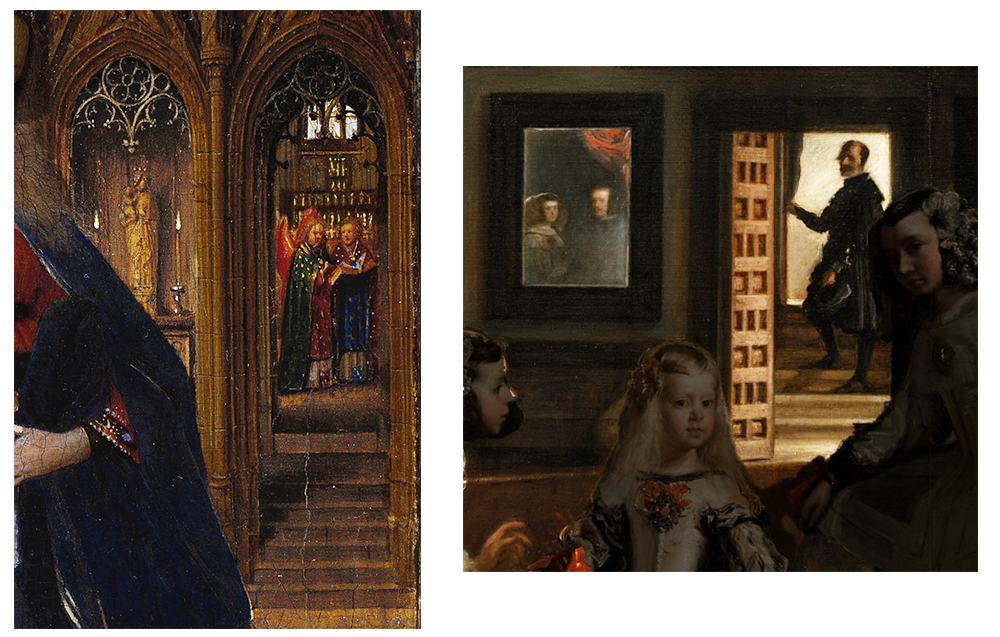
This essay offers a dialogic reflection on Diego Velázquez’s Las Meninas and Jan van Eyck’s Madonna in a Church, examining how two works—radically different in scale, function, and historical context—nonetheless exhibit striking compositional and conceptual parallels. Prompted by the accidental juxtaposition of postcard reproductions, the author explores resonances between the Infanta and the Virgin, particularly in their spatial placement and architectural surroundings. Special attention is given to how both paintings construct vanishing points as complex architectural “sets,” employing open doorways, staircases, lighting effects, and secondary figures to generate layered depth and evoke metaphysical questions. The essay argues that both artists use light as a theological and philosophical agent: Van Eyck as a metaphor for divine incarnation, Velázquez as a temporal loop implicating the viewer in an eternal present. Though no direct historical evidence links Velázquez to the Berlin Madonna, the essay speculates—plausibly—that he may have encountered it or a copy, given his curatorial role and documented admiration for Van Eyck. Ultimately, the essay suggests that both paintings demonstrate a shared ambition: to transcend temporal and material limits through the virtuosity of their medium, positioning the act of painting itself as a vehicle of incarnation and timeless presence.
Leave a Reply