1. Introduction
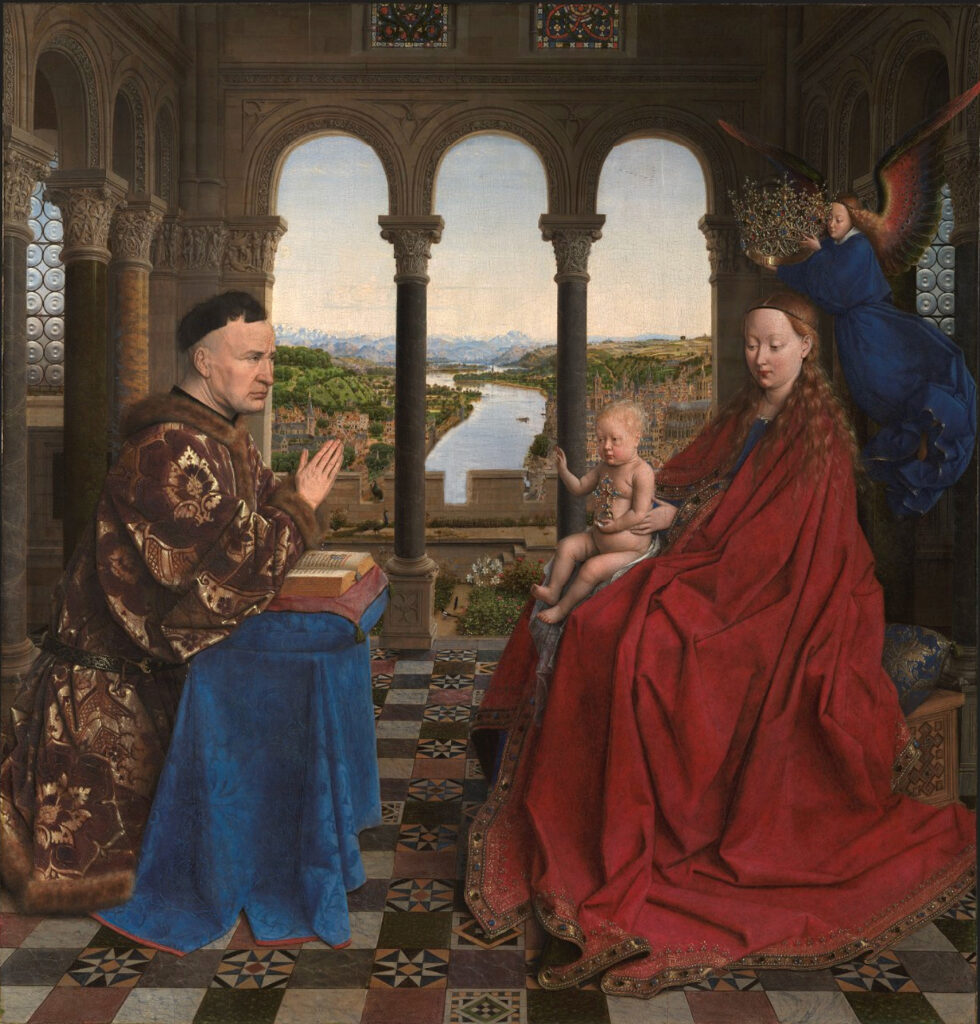
When you look at The Madonna of Chancellor Rolin, your eyes are directed not to the kneeling chancellor or to the Virgin and Child in the foreground but to the top third of the picture, directly toward the center, where a conspicuous island on a river interrupts the horizon. Although the chancellor occupies a considerable portion of the image, the viewer’s gaze must be actively diverted in order to rest on him or on the Madonna. Instead, the eye is irresistibly drawn to the center of the painting, to the river, the island, and upward toward the distant sky. This occurs regardless of the viewer’s distance or angle, which indicates that the painter intended the eye to travel toward the middle and upward through the picture’s vertical axis, indicating a movement of ascent.
If we focus on that upper middle section for a moment—which the composition compels us to do—we see a pattern emerge: more than a pattern, a path or sequence, almost a perfectly straight line through the center of the painting. From the background to the foreground, the sequence consists of the almost translucent blue-and-white mountain that seems to merge with the sky on the horizon, the grayish-brown mountain directly in front of it, the island on the river, the man wearing a red turban, the cluster of lilies in the garden, and then, following the line of uninterrupted tile across the floor, the viewer. Why such deliberate intention by the artist to draw us into the middle section of the painting? Why devise such a cleverly crafted sequence that leads from the viewer’s gaze straight to the clear blue sky and back again? Why pull our attention there when, presumably, the focus of the painting is the chancellor’s piety or the Virgin and Child? The short, inevitable answer is: neither is the focus of the painting. That challenges many assumptions about the work and its commission.
Despite the breathtaking and technically impressive restoration of The Madonna of Chancellor Rolin led by Annie Hochart-Giacobbi and Patrick Mandron, as well as the groundbreaking scholarly research led by Sophie Caron for the corresponding exhibition and catalog, this van Eyck masterpiece remains largely mysterious. Although it is the nature of masterpieces to be so (to paraphrase Jonathan Brown), I would like to build on Caron’s work to suggest a few possibilities that may help us take a few steps further in understanding what this painting communicates. Although, as a masterpiece, I do not believe this image can be reduced to any single theme, objective, or technique, I would like to suggest the possibility of unlocking many of its secrets by viewing it through the lens of visual exegesis. I propose that The Madonna of Chancellor Rolin is an immersive devotional object structurally modeled on specific biblical texts that require the viewer to read the picture closely, much like a book of hours, as Sophie Caron has suggested. However, whereas Caron suggests it should be read as a text (which I agree with), I will attempt to demonstrate that it is based on texts. These texts, in conjunction, were woven together by the artist, so to speak, to create a layered visual representation of an eschatological system, likely in keeping with late-medieval traditions of the Ars Moriendi and peregrinatio.
It is difficult to interpret and untangle, particularly from a modern perspective, because it simultaneously addresses and develops multiple complex theological ideas drawn from scriptural sources of different genres. Visually, this is demonstrated by, among other things, the different perspectives from which it was designed to be viewed, likely by different kinds of viewers. In this sense, Caron cogently advocates understanding the object as meant for two modes of viewing: from up close and from afar. Up close, the amount of small-scale detail suggests viewing in a quiet, intimate, personal devotional setting of deep prayer and reflection. But the image is also clearly meant to be seen from a distance for a different audience, offering a second reading, experience, and function: devotional for him in life; afterward, from a distance, for those who would pray for him.
In fact, building on the thesis the Louvre catalog proposes regarding the painting’s possible intended viewing location within the Saint Sebastian Chapel at Notre-Dame du Châtel, I would go further and suggest this second viewing experience was meant to be had from a very specific angle: off to the viewer’s left-hand side, as if one were closer to Rolin than to the Virgin. When viewed from this angle, not only does the journey’s path along the steps of the central axis become clearer and straighter, but this angle also helps account for the awkward proportions of the figures in the foreground in relation to the architecture. Tellingly, so does the difference in the qubba’s interior light. In the uppermost region, above the capitals, the restoration makes it clearer that the corner above Rolin’s head is noticeably brighter than the corner above the angel. It seems the Rolin Virgin panel was meant for a space in which the light would come from above the viewer’s right shoulder.
In order to develop the thesis regarding van Eyck’s visually quoting and paraphrasing specific biblical texts, we must first look at the painting in detail, both up close and from farther away. To do so, we will use the digital version available on the Closer to Van Eyck website, an invaluable resource for this analysis. The artist’s technique lends itself well to the thesis put forth in these pages. His method makes the painting legible in the sense that everything intended to be read is clearly visible and easy to identify: the peacocks look like peacocks, the church towers and spires are clearly church towers and spires, the magpies look like magpies, and so forth. Unlike abstract art, one need not freely interpret shapes and colors in the hope of unlocking a deeply personal interpretation. Here, things are what they appear to be, and they allow us to view the painting through a mimetic lens, though that is not to say a strictly realistic one; the deliberate distortions of anatomical and perspectival proportions are a reminder of that. So now, let us turn to a detailed look at the work.
Leave a Reply